Quick answer
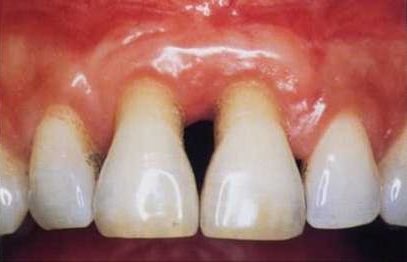
Gum tissue that has already left the root does not grow back on its own. No toothpaste, oil, rinse or supplement has been shown to put it back, and the only approach with real evidence for covering an exposed root is surgical grafting.[8] What genuinely reverses is everything around the recession – the inflammation, the bleeding, the swelling, the shallow pockets, the sensitivity. That matters more than it sounds, because those are what decide whether the recession stops where it is or keeps advancing. The useful question is not "how do I regrow it" but "which engine is driving mine – mechanical or inflammatory?"
What's in this guide
- The Honest Answer, Up Front
- Recession Is Almost Universal – That's Not the Alarm
- Two Different Engines, Two Different Fixes
- Why Treating It Can Make It Look Worse
- What Actually Reverses
- What Doesn't, No Matter What the Label Says
- What a Dentist Can Actually Do
- The Root Is Exposed. Now Protect It.
- A 90-Day Plan That's Honest About Its Ceiling
- FAQ
- References
The Honest Answer, Up Front
You looked in the mirror, noticed your teeth look longer than they used to, and searched for a way to fix it. So let me not waste the first four hundred words on suspense.
Gum tissue does not creep back up a root because you changed toothpaste. It does not regenerate because you swished coconut oil, massaged your gums with aloe, or started a supplement. If a page tells you otherwise, it is selling you something on a premise that no controlled trial supports.
There is one phenomenon that looks like an exception, and it is worth naming because you will find it quoted out of context. Periodontists describe creeping attachment – the gum margin migrating back up the tooth over months. It is real. But the literature reviewing it describes it as something observed after mucogingival surgery, during healing, and even then the review's own conclusion is that the coverage "is not always complete nor entirely predictable."[9] It is a post-surgical bonus, not a home remedy.
So why read the rest?
Because "it doesn't grow back" and "there's nothing you can do" are completely different statements, and only the first one is true. Recession is a process, not a scar. What you do over the next three months decides whether the line you are looking at is the final one or the halfway point.
Recession Is Almost Universal – That's Not the Alarm
Before you panic, some calibration.
A review of the epidemiology found recession in 88% of people aged 65 and over and 50% of people aged 18 to 64, with more than half the population showing at least one site of 1 mm or more.[2] A 2024 clinical study across seven European countries examined 3,551 adults with calibrated examiners and found recession of at least 1 mm in 87.9% of them.[3]
Read that again, because it reframes the whole question. Having recession is close to normal. The clinically meaningful question is not whether you have it – almost everyone does – but whether yours is progressing, and what's driving it.
The same epidemiological review makes a second point that quietly demolishes a lot of self-blame: recession was found in patients with both good and poor oral hygiene, and it is described as multifactorial, with one type tied to anatomy and another to physiological or pathological factors.[2] Some of the people with the most recession are the most fastidious brushers in the room.
Two Different Engines, Two Different Fixes
This is the section that changes what you do tomorrow morning.
Recession gets driven by two fundamentally different mechanisms, and they need opposite responses. Treating the wrong one is why people spend a year on a routine that changes nothing.
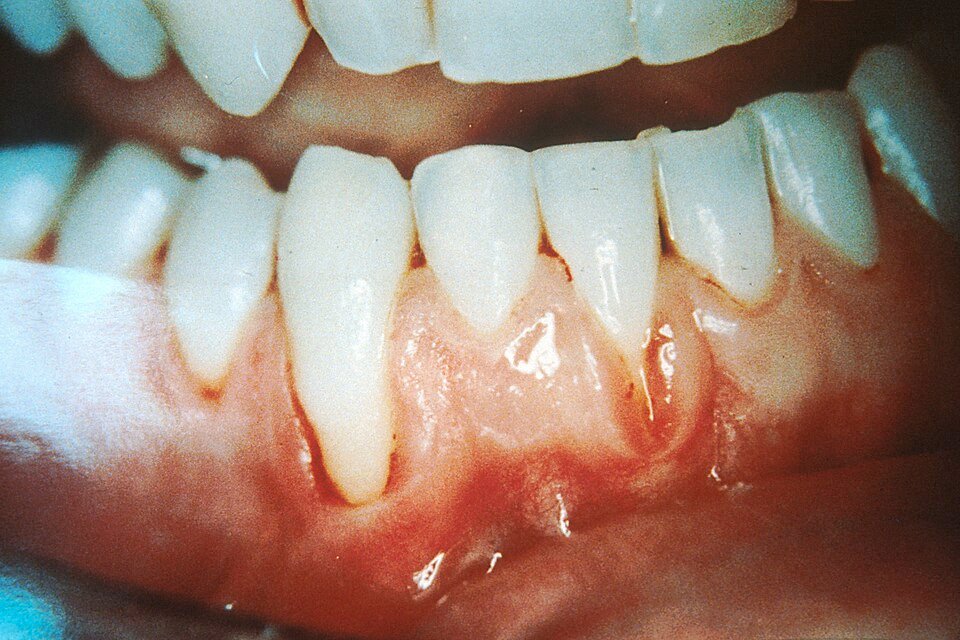
The mechanical engine
- Gum margin looks thin, firm and pink – not red or puffy
- Often a V-shaped notch on one or two teeth, frequently on the side you brush hardest
- Little or no bleeding when you brush
- Common on canines and premolars, on the cheek-facing surfaces
- Associated with thin tissue over a prominent root, a piercing, or an appliance rubbing
The inflammatory engine
- Gum margin looks red, swollen, glossy; bleeds on brushing or flossing
- Usually more generalised, several teeth at once
- Bad breath that returns quickly after cleaning
- Pockets deepen alongside the recession
- This is periodontitis, and it takes bone with it
Note what is not on either list: a supplement fixing the first one. If your recession is mechanical, the entire treatment is changing the mechanical input. No probiotic, rinse or diet compensates for a hard brush used with force twice a day.
Most cases are not purely one engine. Thin tissue over a prominent root plus a scrubbing technique plus untreated gingivitis is the common real-world combination, which is why the plan at the end addresses all three.
Why Treating It Can Make It Look Worse
Here is the finding almost nobody warns patients about, and it causes real distress.
You go for a deep cleaning – scaling and root planing. Six weeks later your gums have stopped bleeding, they feel better, and they look more receded than before. It is easy to conclude the hygienist damaged them.
They didn't. A re-review of the scaling and root planing literature, pooling studies that reported attachment levels and pocket depths, opens with the blunt statement that gingival recessions inevitably occur during healing after scaling and root planing. The measured increase was modest: a median of about 0.14 to 0.20 mm at three months in chronic periodontitis without antibiotics, and roughly 0.20 to 0.35 mm at six months across the groups.[5]
The mechanism is simple. Inflamed tissue is swollen. Swollen tissue sits higher on the tooth than healthy tissue and hides part of the root exposure. When the inflammation resolves, the tissue shrinks back to where the attachment actually is.
That diagram explains why a dentist charts pocket depths instead of just looking. And it explains why the number that matters most is the one you cannot see in a mirror.
How much does that hidden number matter? In a cohort of 172 patients followed for an average of 11.3 years on maintenance care, sites with a residual pocket of 5 mm carried odds of tooth loss around 5.8 to 7.7 times higher than sites at 3 mm or less; at 6 mm the odds rose to roughly 9.3 to 11.0, and at 7 mm or more they climbed dramatically further. The authors' conclusion was that residual pockets of 6 mm or more represent an incomplete treatment outcome and require further therapy.[6]
That is the strongest argument in this article for getting measured rather than self-managing.
What Actually Reverses
Now the constructive half. These are the things that genuinely change, in the direction you want, and most of them change within weeks.
| What | Can it reverse? | Typical timeframe | What moves it |
|---|---|---|---|
| Bleeding on brushing | Yes, fully | 1–3 weeks | Consistent plaque removal at the gum margin, including between teeth |
| Redness and swelling | Yes, fully | 2–4 weeks | Same – this is gingivitis, and gingivitis is reversible |
| Shallow pockets (up to ~4 mm) | Usually | 1–3 months after professional cleaning | Scaling and root planing plus maintained home care[6] |
| Root sensitivity | Yes, largely | 2–12 weeks | Desensitising dentifrices – three different actives all cut sensitivity by roughly 80–90% at 12 weeks in a head-to-head trial[13] |
| Progression of the recession | Can be halted | Ongoing | Removing the driver – mechanical, inflammatory, or both |
| The exposed root itself | No, not at home | — | Only surgical root coverage puts tissue back[8] |
Five of six rows are green or amber. That is the actual answer to "can I do anything about receding gums" – and it is a far better answer than the false one.
What Doesn't, No Matter What the Label Says
Fair is fair. If I'm going to tell you what works, I owe you the list of what I checked and found wanting.
Oil pulling
The strongest recent test randomised 40 people to pull with sesame oil or distilled water, 15 minutes every morning for eight weeks. The oil group did reduce plaque significantly more than water – a median 18.98% versus 10.49% full-mouth reduction. But there were no significant changes in the gingival bleeding index and no significant microbiological differences, and the authors themselves flagged that a study bias could not be ruled out.[12]
So: a modest extra bit of plaque removal, no measurable effect on gum inflammation, for 105 minutes a week. Nothing here touches recession.
"Gum regrowth" toothpastes, gels and rinses
There is no product category with trial evidence for regenerating gingival tissue over an exposed root without surgery. Products that reduce inflammation are useful for the reasons in the previous section. That is a different claim, and the honest ones make the different claim.
Probiotics, stated precisely
I run a site about the oral microbiome, so this is the paragraph where I have the most to lose by being straight with you. Oral probiotics do not regrow gum tissue. Nothing does.
What they have is evidence for something smaller and more specific. In a placebo-controlled trial of 30 chronic periodontitis patients, Lactobacillus reuteri lozenges taken twice daily for 12 weeks alongside scaling and root planing produced significantly more pocket depth reduction and more attachment gain in moderate and deep pockets than the cleaning alone, plus a greater reduction in Porphyromonas gingivalis.[10] A meta-analysis of eleven randomised trials put the pooled effect at roughly 0.40 mm additional pocket reduction and 0.30 mm additional attachment gain at three months – and stated plainly that the favourable effect was short-term.[11]
Three tenths of a millimetre, as an add-on to professional treatment, measured at three months. That is a real finding and it is nowhere near a new gum line. Anyone selling you the second thing using the first thing's research is misrepresenting it.
If the inflammatory engine is the one driving yours, supporting the bacterial ecosystem is a reasonable piece of the maintenance side – alongside the cleaning, not instead of it. We went through one popular oral probiotic in detail, including exactly which claims its own evidence does not cover.
Read the ProDentim review →What a Dentist Can Actually Do
Two categories, and they are not the same appointment.
Stop the progression
Scaling and root planing to remove the biofilm and calculus below the gum line, then a maintenance interval chosen by how your pockets respond. Expect the visible recession to increase slightly as the swelling resolves – that is the finding from the section above, and it is a sign the treatment worked, not that it failed.[5]
Put tissue back
This is surgery, and it is the only thing on this page that covers an exposed root. A network meta-analysis of 38 randomised trials covering 830 patients and 1,265 recession defects compared the main techniques head to head. A subepithelial connective tissue graft combined with a coronally advanced flap ranked as the most efficient approach for mean root coverage, complete root coverage and gain in keratinized tissue at both six and twelve months, and the authors concluded it remains the gold standard for single recession defects.[8]
Whether that is worth it for you depends on how much root is exposed, whether it is getting worse, whether it hurts, and how much it bothers you aesthetically. Those are questions for a periodontist with a probe in their hand, not for an article.
Book the appointment, don't optimise your routine, if:
- Any adult tooth feels loose or has shifted position
- There is pus, a swelling, or a bad taste that keeps coming back
- Bleeding continues after three to four weeks of genuinely consistent, gentle cleaning
- You can see the recession advancing month to month
- A dentist has previously told you about pockets of 5 mm or more and you have not been back[6]
The Root Is Exposed. Now Protect It.
An exposed root is not just an aesthetic problem. It is a different material with different vulnerabilities, and this is the part most articles skip entirely.
Enamel does not cover it. What is exposed is cementum and dentine – softer, more prone to abrasion, and more prone to decay than the crown of the tooth. The epidemiological review specifically notes that exposed root surfaces are prone to abrasion and to root caries.[2]
Sensitivity comes with the territory. In that 3,551-person European study, dentine hypersensitivity was present in 75.9% of participants and was significantly associated with recession.[3] If cold drinks have started making you flinch, that is the explanation, not a coincidence.
The good news is that this part responds well. In a 12-week randomised trial of 120 people, three different desensitising formulations – calcium sodium phosphosilicate, potassium nitrate and stannous fluoride – all reduced sensitivity substantially, with 12-week reductions in the region of 79% to 91% depending on the product and the stimulus.[13] They differed mainly in how fast they got there, not in whether they got there.
Four habits that protect exposed root surfaces
- Soft bristles, and let the brush do the work. Pressure adds abrasion to a surface that is already softer than enamel. In the European study, powered toothbrush users had significantly lower sensitivity, tooth wear and bleeding scores – most powered brushes cap the force for you.[3]
- Small circles, not horizontal scrubbing. The sawing motion is the one that concentrates wear right at the gum line.
- Wait after anything acidic. Citrus, wine, vinegar, fizzy drinks – give it half an hour before brushing so you are not abrading a softened surface.
- Use fluoride, and use it on the root. Root caries is the underrated risk here, and fluoride is the cheapest protection available against it.
A 90-Day Plan That's Honest About Its Ceiling
What follows will not give you back a millimetre of gum. It is built to do the two things that are actually achievable: stop the progression, and take the inflammation out of the tissue that remains.
Weeks 1–2: measure and stop the damage
- Photograph it. Same phone, same light, lips retracted the same way, once a fortnight. Recession moves too slowly for memory to track it honestly.
- Book a periodontal charting. You need the number under the gum, not just the one in the mirror.[6]
- Switch to a soft brush and check your technique in a mirror. If you are scrubbing horizontally, that alone is worth fixing this week.
- Remove obvious mechanical irritants – a lip or tongue piercing sitting against the gum, a habit of holding anything against one spot, an appliance that rubs.
Weeks 3–8: take the inflammation out
- Clean between the teeth daily. This is where the biofilm that drives the inflammatory engine actually lives – a brush cannot reach it.
- Complete whatever professional treatment was recommended. Expect the gum line to look slightly worse as the swelling goes. That is the treatment working.[5]
- Start a desensitising toothpaste if the roots are sensitive, and give it the full 12 weeks before judging it.[13]
- Stop the overcorrection. Brushing harder because you are worried is the single most counterproductive response available.
Weeks 9–12: maintain, and decide
- Re-chart the pockets. Sites still at 6 mm or more mean the treatment is incomplete and needs more, not more patience.[6]
- Compare the photographs. Stable is the win condition. Stable is what success looks like here.
- If it still bothers you aesthetically or it is still advancing, ask about root coverage surgery. That is the conversation where an actual millimetre becomes possible.[8]
- Consider the ecosystem side for maintenance if the inflammatory engine was yours – as the adjunct the evidence describes, not the fix.[10][11]
Underneath all of this is a shift in framing that took me an embarrassingly long time to make. Your mouth is not a surface to be scrubbed cleaner and cleaner until the problem goes away – it is an ecosystem of several hundred bacterial species in a structured community,[1] and recession is what happens when that community, or your own toothbrush, gets to win an argument with your gum tissue for long enough. The longer version of how that reframing changed what I do is on the home page.
Frequently asked questions
Can receding gums grow back naturally?
No. Gum tissue that has migrated away from a tooth doesn't regenerate over the exposed root on its own, and no toothpaste, oil, rinse or supplement has been shown to put it back. The coronal migration periodontists call creeping attachment does happen, but the literature describes it as a phenomenon following mucogingival surgery – and even then it's neither always complete nor entirely predictable. What can genuinely reverse is the inflammation, bleeding, swelling and shallow pockets around the recession, and that's what determines whether it keeps advancing.
What actually stops gum recession from getting worse?
It depends which of the two drivers is behind it. If the driver is mechanical – hard bristles, a scrubbing technique, heavy pressure, a piercing rubbing the gum – then changing that input is the whole treatment, and no product substitutes for it. If the driver is inflammatory, meaning gum disease, then removing the biofilm and calculus below the gum line and keeping it removed is what halts progression. Residual pockets are the measurable marker: in an 11-year maintenance cohort, sites with pockets of 6 mm or more carried roughly nine to eleven times the odds of tooth loss compared with sites at 3 mm or less.
Why do my gums look more receded after a deep cleaning?
Because the swelling left. Inflamed tissue is puffed up and sits higher on the tooth than healthy tissue, hiding part of the root exposure. Once the inflammation resolves, the tissue settles back to where the attachment actually is. A re-review of the scaling and root planing literature found recession consistently increases during healing, by a median of roughly 0.14 to 0.35 mm at three to six months. That isn't damage from the cleaning – it's the measurement finally telling the truth.
Does a gum graft work, and is it the only way to cover an exposed root?
Surgical root coverage is the only approach with evidence that it puts tissue back over an exposed root. A network meta-analysis of 38 randomised trials covering 830 patients and 1,265 recession defects ranked a subepithelial connective tissue graft combined with a coronally advanced flap as the most efficient technique for mean root coverage, complete root coverage and keratinized tissue gain at six and twelve months, and concluded it remains the gold standard for single recession defects. It's a real surgical procedure with real trade-offs, and it's a decision for a periodontist rather than a website.
Do oral probiotics help with receding gums?
Not for regrowing tissue – nothing does that. There's evidence for a smaller, more specific claim. In a placebo-controlled trial, Lactobacillus reuteri lozenges taken alongside scaling and root planing produced significantly more pocket depth reduction and attachment gain in moderate and deep pockets than the cleaning alone. A meta-analysis of eleven randomised trials put the pooled numbers at about 0.40 mm more pocket reduction and 0.30 mm more attachment gain at three months, and explicitly called the benefit short-term. That's a fraction of a millimetre on the inflammatory side of the problem, as an adjunct to professional treatment.
Does oil pulling help receding gums?
There's no evidence it does. The best recent test randomised 40 people to pull with sesame oil or distilled water for 15 minutes every morning for eight weeks. The sesame oil group did reduce plaque significantly more than water – a median 18.98% versus 10.49% – but there were no significant changes in the gingival bleeding index and no significant microbiological differences, and the authors noted a possible study bias. Modest extra plaque removal isn't the same as reversing recession, and it's a large time cost for it.
Is receding gums always a sign of gum disease?
No, and that's why the two-engine distinction matters. A review of the epidemiology found recession in patients with both good and poor oral hygiene and described it as multifactorial – one type tied to anatomy, another to physiological or pathological factors. Thin tissue over a prominent root can recede in a mouth with no disease at all. The way to tell them apart is whether the surrounding tissue is red, swollen and bleeding, and whether a probe finds depth underneath.
References
- Dewhirst FE, Chen T, Izard J, Paster BJ, Tanner AC, Yu WH, Lakshmanan A, Wade WG. The human oral microbiome. Journal of Bacteriology, 2010; 192(19):5002-17. PubMed 20656903
- Kassab MM, Cohen RE. The etiology and prevalence of gingival recession. Journal of the American Dental Association, 2003; 134(2):220-5. PubMed 12636127
- West NX, Davies M, Sculean A, Jepsen S, Faria-Almeida R, Harding M, Graziani F, Newcombe RG, Creeth JE, Herrera D. Prevalence of dentine hypersensitivity, erosive tooth wear, gingival recession and periodontal health in seven European countries. Journal of Dentistry, 2024; 150:105364. PubMed 39317300
- Rajapakse PS, McCracken GI, Gwynnett E, Steen ND, Guentsch A, Heasman PA. Does tooth brushing influence the development and progression of non-inflammatory gingival recession? A systematic review. Journal of Clinical Periodontology, 2007; 34(12):1046-61. PubMed 17953693
- Kaufmann ME, Wiedemeier DB, Zellweger U, Solderer A, Attin T, Schmidlin PR. Gingival recession after scaling and root planing with or without systemic metronidazole and amoxicillin: a re-review. Clinical Oral Investigations, 2020; 24(3):1091-1100. PubMed 31938962
- Matuliene G, Pjetursson BE, Salvi GE, Schmidlin K, Brägger U, Zwahlen M, Lang NP. Influence of residual pockets on progression of periodontitis and tooth loss: results after 11 years of maintenance. Journal of Clinical Periodontology, 2008; 35(8):685-95. PubMed 18549447
- Morris JW, Campbell PM, Tadlock LP, Boley J, Buschang PH. Prevalence of gingival recession after orthodontic tooth movements. American Journal of Orthodontics and Dentofacial Orthopedics, 2017; 151(5):851-859. PubMed 28457262
- Chambrone L, Botelho J, Machado V, Mascarenhas P, Mendes JJ, Avila-Ortiz G. Does the subepithelial connective tissue graft in conjunction with a coronally advanced flap remain as the gold standard therapy for the treatment of single gingival recession defects? A systematic review and network meta-analysis. Journal of Periodontology, 2022; 93(9):1336-1352. PubMed 35451068
- Wan W, Zhong H, Wang J. Creeping attachment: a literature review. Journal of Esthetic and Restorative Dentistry, 2020; 32(8):776-782. PubMed 32896991
- Teughels W, Durukan A, Ozcelik O, Pauwels M, Quirynen M, Haytac MC. Clinical and microbiological effects of Lactobacillus reuteri probiotics in the treatment of chronic periodontitis: a randomized placebo-controlled study. Journal of Clinical Periodontology, 2013; 40(11):1025-35. PubMed 24164569
- Song D, Liu XR. Role of probiotics containing Lactobacillus reuteri in adjunct to scaling and root planing for management of patients with chronic periodontitis: a meta-analysis. European Review for Medical and Pharmacological Sciences, 2020; 24(8):4495-4505. PubMed 32373987
- Zürcher C, Vukoje K, Kleiner EM, Kuster SM, Jäger-Larcher LK, Heller I, Eick S, Nagl M, Kapferer-Seebacher I. The plaque reducing efficacy of oil pulling with sesame oil: a randomized-controlled clinical study. Clinical Oral Investigations, 2025; 29(1):53. PubMed 39786483
- Sharma N, Roy S, Kakar A, Greenspan DC, Scott R. A clinical study comparing oral formulations containing 7.5% calcium sodium phosphosilicate (NovaMin), 5% potassium nitrate, and 0.4% stannous fluoride for the management of dentin hypersensitivity. Journal of Clinical Dentistry, 2010; 21(3):88-92. PubMed 21207920
Citations are provided for context on gum recession and oral health in general – they are not endorsements of any specific commercial product, and nothing here replaces advice from your own dentist. Gum recession accompanied by loose teeth, pain, pus or rapid change needs an in-person examination, not a reading list.