Quick answer
A white tongue is usually tongue coating: a greyish-white layer of shed cells, food debris and bacteria packed between the papillae on the top of the tongue, and the main source of intra-oral bad breath.[1] The usual drivers are low saliva, mouth breathing, smoking, a soft diet and never cleaning the tongue. The two things worth ruling out are oral thrush (wipes off, leaves a red raw base, often burns)[4] and any white patch that will not scrape off at all - that one gets examined in person, not researched online.
What's in this guide
What the White Layer Actually Is
Run your tongue against the roof of your mouth. That rough texture is thousands of filiform papillae - tiny keratin projections that make the tongue's upper surface behave like carpet rather than tile.
Carpet traps things. Shed epithelial cells, food residue, saliva proteins and bacteria collect between those papillae and form what dentistry calls tongue coating: a greyish-white deposit on the dorsum of the tongue.[1]
The tongue is the largest single microbial habitat in the mouth, and the structure of its surface supports a uniquely complex biofilm.[8] That is not a defect. Everyone has some coating. It becomes a visible white layer when the rate of build-up outruns the rate at which saliva, food and friction clear it away.
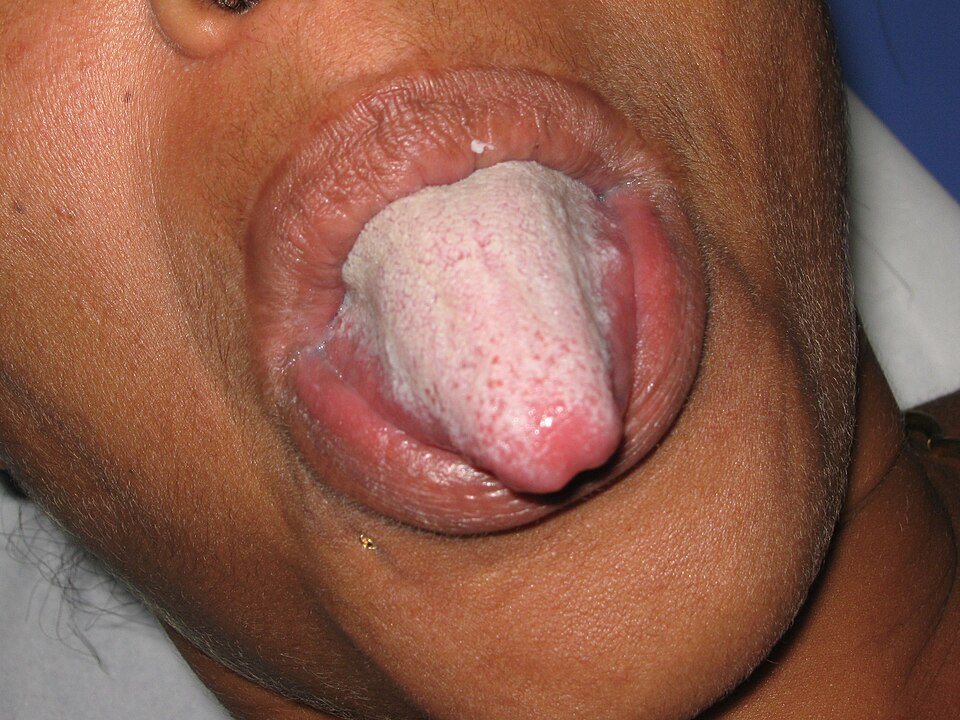
Coating matters for one practical reason beyond appearance: it is the principal source of intra-oral halitosis. The bacteria living in it break down proteins into volatile sulfur compounds, which is what other people smell.[1][3]
7 Causes of a White Tongue
1. Dry mouth
Saliva is the tongue's washing system. It rinses loose debris, dilutes bacterial by-products and keeps the surface moving. When flow drops, coating accumulates.
Dehydration is the everyday version. The chronic version is xerostomia, and the most common cause of that in adults is medication - a long list including antidepressants, antihistamines, diuretics, antihypertensives and opioids, with the effect compounding when several are taken together.[6] Dry mouth is also a recognised predisposing factor for the dramatic-looking variant, black hairy tongue.[5]
2. Mouth breathing and snoring
Air moving over the tongue all night dries the surface at exactly the hours when saliva production is already at its lowest. People who wake up with a thick white tongue and a dry mouth are usually describing a breathing pattern, not a hygiene failure.
3. Never cleaning the tongue
Brushing the teeth does nothing for the tongue dorsum. If the coating has never been mechanically disturbed, the only thing removing it is friction from food - and modern diets are soft. This is the single most common reason a tongue looks white in an otherwise healthy mouth.
4. Smoking, coffee and strong tea
All three are listed among the predisposing factors for hairy tongue, where the filiform papillae elongate and retain even more debris. Smoking, heavy coffee or black tea consumption, poor oral hygiene and dry mouth appear together in the risk profile.[5] The same habits thicken ordinary coating long before anything looks hairy.
5. Recent antibiotics or an inhaled steroid
Both disturb the balance of species in the mouth and open room for fungal overgrowth. That is the classic setup for oral candidiasis - an overgrowth of Candida albicans, most familiar as thrush, whose clinical presentations are broadly split into white and erythematous forms.[4] If you use a steroid asthma inhaler, rinsing your mouth after every dose is the standard preventive step.
6. A shifted microbial community
Here is the finding that reframes the whole topic. When researchers sequenced tongue coating from people with bad breath and compared it with healthy controls, they did not simply find more bacteria - they found a different community. Microbial richness and diversity were higher in the halitosis group, with species from Actinomyces, Prevotella, Veillonella and Solobacterium significantly more abundant, while Rothia and Streptococcus species moved the opposite way.[2]
An earlier study measuring gases directly found the same pattern with a functional link: several genera correlated with higher volatile sulfur compound readings, and one - Bergeyella - correlated with lower ones.[3] Composition, not just quantity.
7. Illness, fasting and dehydration
A short-lived white tongue during a fever, a stomach bug, a hangover or a long fast is ordinary. Less eating and drinking means less mechanical clearance and less saliva. It resolves on its own within days of eating and drinking normally.
The Scrape Test: Coating, Thrush, or Something Else
One home check separates most of the possibilities. Run a tongue scraper or the back of a spoon gently over the white area, once, without pressing hard. Then look at what happened.
| What you see | What it suggests | Other clues | What to do |
|---|---|---|---|
| Lifts off easily, normal pink underneath | Ordinary tongue coating | Painless; worst in the morning; often with bad breath[1] | Daily cleaning plus the causes above |
| Creamy plaques wipe off, red raw base beneath | Possible oral thrush (candidiasis) | Burning or soreness; recent antibiotics, inhaled steroid, dentures, diabetes[4] | See a dentist or doctor - it needs antifungal treatment |
| Will not come off at all | Needs professional assessment | A fixed white patch or plaque; may be painless | Book an appointment - do not keep scraping |
| Dark, thick, carpet-like elongated papillae | Hairy tongue | Smoking, coffee/tea, dry mouth, some medications[5] | Benign; remove triggers and debride gently |
| Map-like pink patches with white borders that move around | Geographic tongue | Shape changes week to week; usually harmless | Reassurance; mention it at your next dental visit |
When It Needs a Professional
Almost all white tongue is benign. A short list is not.
Book an appointment if any of these apply
- A white patch that does not scrape off, especially if it is fixed in one spot
- Anything on one side only, rather than spread across the dorsum
- Pain, burning, ulceration or bleeding
- No change after two weeks of consistent cleaning and hydration
- A lump, a hard area, or difficulty swallowing
- Any white area in someone who smokes or drinks heavily - the threshold for getting it looked at should be lower, not higher
This is a page about the common cause. It is not a diagnosis, and a tongue is one of the easiest things in medicine for a professional to examine in five minutes.
What Actually Removes It - and How Long That Lasts
Mechanical cleaning works, and the evidence is real but modest. A systematic review of randomized and controlled trials concluded that tongue brushing or scraping, in addition to toothbrushing, has the potential to reduce both breath odour and tongue coating.[7]
A Cochrane review of tongue scraping specifically for halitosis was more restrained. It found weak and unreliable evidence of a small but statistically significant reduction in volatile sulfur compounds when a tongue scraper or cleaner was used rather than a toothbrush - and in one of the two trials, the reduction could no longer be detected 30 minutes after the intervention in any group.[9]
Antimicrobial rinses were studied too. Reviews of tongue biofilm control found that both mechanical and chemical approaches produced reductions in halitosis-related measures that were transient and limited in time, with most studies designed only as short-term models.[8]
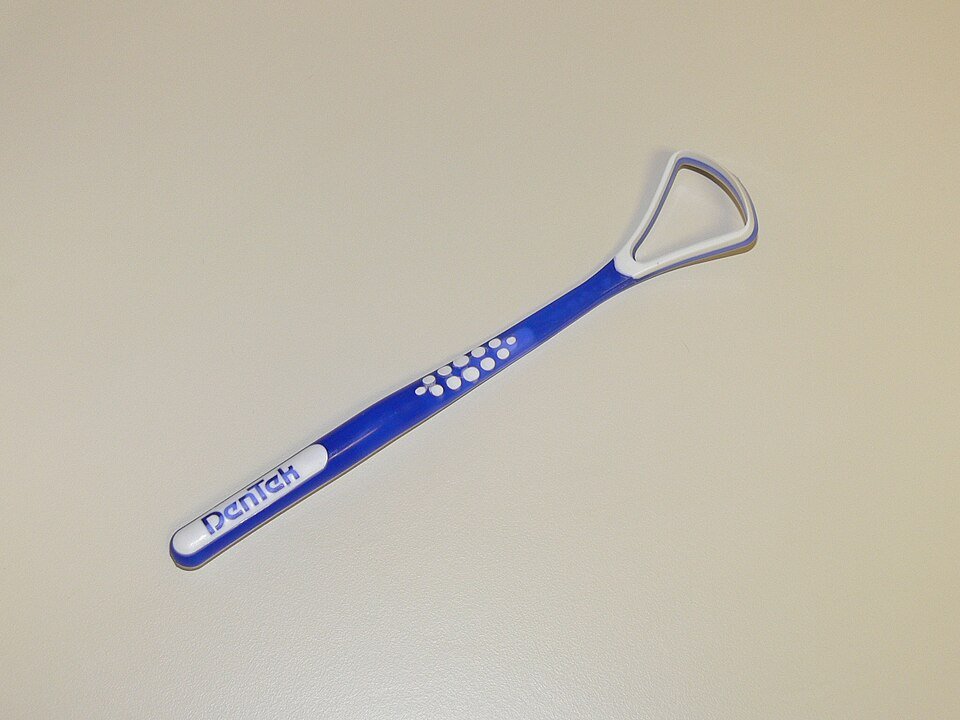
How to clean a tongue properly
- Scraper or a soft brush - the trials found both work[7]
- Start as far back as you can tolerate; the back third is where the coating and the smell live
- Light pressure, front-to-back, rinse the tool between passes
- Three or four passes is plenty
- Once daily, at night, when overnight dryness is about to do its work
What doesn't help
- Scrubbing hard - it irritates the surface without removing more
- Mouthwash as the only measure; it masks odour and its effect on coating is short-lived[8]
- Antifungal home remedies for something that is not fungal
- Whitening toothpaste, which has nothing to do with the tongue
- Cleaning twice as hard on days it looks worse
Why It Comes Straight Back
You scrape. It looks clean. By morning the white layer is back, and it is easy to conclude you did it wrong.
You didn't. Scraping removes a deposit; it does not change the community that produces the deposit. The tongue dorsum hosts hundreds of species in a structured biofilm,[10] saliva flow falls overnight, and the population that was there yesterday is the population that rebuilds tonight. When that community is the shifted one associated with halitosis - richer in Prevotella, Veillonella, Actinomyces, Solobacterium, poorer in Rothia and Streptococcus[2] - removal alone leaves the cause intact.
That distinction is the whole argument for treating the mouth as an ecosystem rather than a surface to be cleaned, which is what the pillar guide walks through: Oral Microbiome 101.
One trial makes the point better than any theory. Twenty-eight people with tongue-coating-associated halitosis took Streptococcus salivarius K12 lozenges or placebo for 30 days - deliberately without scraping their tongue or using an antiseptic rinse first. Scores improved against their own baseline, but there was no statistically significant difference between the probiotic and placebo groups, and the authors concluded that the coating has to be removed before K12 is used.[11]
The sequence, not the product
Clear the surface first. Then try to influence what grows back. Doing it in the other order is how a reasonable idea gets tested badly and written off - which is close to what happened in that trial.
Which strains actually have evidence behind them - and which are marketing - is a separate question we went through one strain at a time, including where the research is thin.
Do oral probiotics actually work? →If you want the longer version - how I stopped treating a coated tongue as a cleaning failure and started treating it as an ecosystem that had drifted, and what I changed daily as a result - that story is on the home page.
A 14-Day Tongue Reset
Two weeks is long enough to know whether the cause is mechanical, and short enough that you will actually finish it.
- Clean the tongue once a day, at night. Scraper or soft brush, light pressure, back third included.[7]
- Fix the dryness. Water on the desk, not just at meals. If you take a medication that dries you out, ask a pharmacist whether it is a known culprit before changing anything yourself.[6]
- Rinse after your inhaler, every dose, if you use a steroid one.[4]
- Cut one trigger. The third coffee, the last cigarette of the evening, the alcohol-based rinse.[5]
- Photograph your tongue on day 1 and day 14, same light, same time of day. Memory is unreliable about slow visual change; a phone is not.
Frequently asked questions
Is a white tongue serious?
Usually not. The common version is tongue coating - a greyish-white layer of shed cells, food debris and bacteria held between the papillae on the tongue's upper surface, and the main source of intra-oral bad breath rather than a disease in itself. What deserves attention is a white patch that doesn't come off when you gently scrape it, a coating on only one side, anything painful or ulcerated, and anything that hasn't changed in two weeks. Those need a dentist or doctor to look at them in person.
How do I tell white tongue from oral thrush?
Use the scrape test. Ordinary coating lifts off easily and leaves normal pink tongue underneath. Thrush - oral candidiasis, an overgrowth of Candida albicans - typically looks like creamy, curd-like plaques that wipe away to reveal a red, raw, sometimes bleeding surface, and it often burns or stings. It's also far more likely after antibiotics, with inhaled steroid asthma inhalers, with dentures, in diabetes, and with weakened immunity. Thrush needs antifungal treatment, so see a clinician rather than scraping harder.
Does scraping your tongue actually work?
For coating and breath odour, yes - with limits. A systematic review of controlled trials found mechanical tongue cleaning, by brush or scraper, reduced breath odour and tongue coating compared with toothbrushing alone. A Cochrane review of tongue scraping for halitosis was blunter: the evidence is weak and unreliable, showing a small but statistically significant reduction in volatile sulfur compounds versus a toothbrush, and in one trial the effect could no longer be detected 30 minutes later. Scraping removes the coating. It doesn't change what regrows.
Why does my tongue turn white again the next morning?
Because scraping is a removal, not a reset. The tongue dorsum is the largest microbial niche in the mouth, and saliva flow drops sharply overnight, so the population rebuilds while you sleep. Studies of tongue-coating microbiota in people with bad breath find a shifted community - more Prevotella, Veillonella, Actinomyces and Solobacterium, relatively fewer Rothia and Streptococcus - rather than simply more bacteria. If the community driving the coating is unchanged, the coating returns on its own schedule.
Do oral probiotics help with tongue coating?
The order appears to matter more than the product. In a randomized placebo-controlled trial, people with tongue-coating-associated halitosis took Streptococcus salivarius K12 lozenges for 30 days without scraping their tongue or using an antiseptic rinse first. Scores improved from their own baseline, but there was no statistically significant difference against placebo, and the authors concluded the coating needs to be physically removed before K12 is used. Clear the surface first, then try to influence what recolonizes it.
References
- Seerangaiyan K, Jüch F, Winkel EG. Tongue coating: its characteristics and role in intra-oral halitosis and general health - a review. Journal of Breath Research, 2018; 12(3):034001. PubMed 29269592
- Zhang Y, Lo KL, Liman AN, Feng XP, Ye W. Tongue-coating microbial and metabolic characteristics in halitosis. Journal of Dental Research, 2024; 103(5):484-493. PubMed 38623900
- Ye W, Zhang Y, He M, Zhu C, Feng XP. Relationship of tongue coating microbiome on volatile sulfur compounds in healthy and halitosis adults. Journal of Breath Research, 2019; 14(1):016005. PubMed 31553956
- Millsop JW, Fazel N. Oral candidiasis. Clinics in Dermatology, 2016; 34(4):487-94. PubMed 27343964
- Gurvits GE, Tan A. Black hairy tongue syndrome. World Journal of Gastroenterology, 2014; 20(31):10845-50. PubMed 25152586
- Barbe AG. Medication-induced xerostomia and hyposalivation in the elderly: culprits, complications, and management. Drugs & Aging, 2018; 35(10):877-885. PubMed 30187289
- Van der Sleen MI, Slot DE, Van Trijffel E, Winkel EG, Van der Weijden GA. Effectiveness of mechanical tongue cleaning on breath odour and tongue coating: a systematic review. International Journal of Dental Hygiene, 2010; 8(4):258-68. PubMed 20961381
- Roldán S, Herrera D, Sanz M. Biofilms and the tongue: therapeutical approaches for the control of halitosis. Clinical Oral Investigations, 2003; 7(4):189-97. PubMed 14513303
- Outhouse TL, Al-Alawi R, Fedorowicz Z, Keenan JV. Tongue scraping for treating halitosis. Cochrane Database of Systematic Reviews, 2006; (2):CD005519. PubMed 16625641
- Dewhirst FE, Chen T, Izard J, Paster BJ, Tanner AC, Yu WH, Lakshmanan A, Wade WG. The human oral microbiome. Journal of Bacteriology, 2010; 192(19):5002-17. PubMed 20656903
- He L, Yang H, Chen Z, Ouyang X. The effect of Streptococcus salivarius K12 on halitosis: a double-blind, randomized, placebo-controlled trial. Probiotics and Antimicrobial Proteins, 2020; 12(4):1321-1329. PubMed 32227309
Citations are provided for context on tongue coating and oral health in general - they are not endorsements of any specific commercial product, and nothing here replaces an in-person examination.